
Interlocking anti-fatigue mat tiles
Interlocking tiles are for covering multiple standing positions, long lines and layouts that change. This page covers when modular beats a single mat, when it doesn’t, and the specs to confirm for a production line or multi-station rollout.
In short
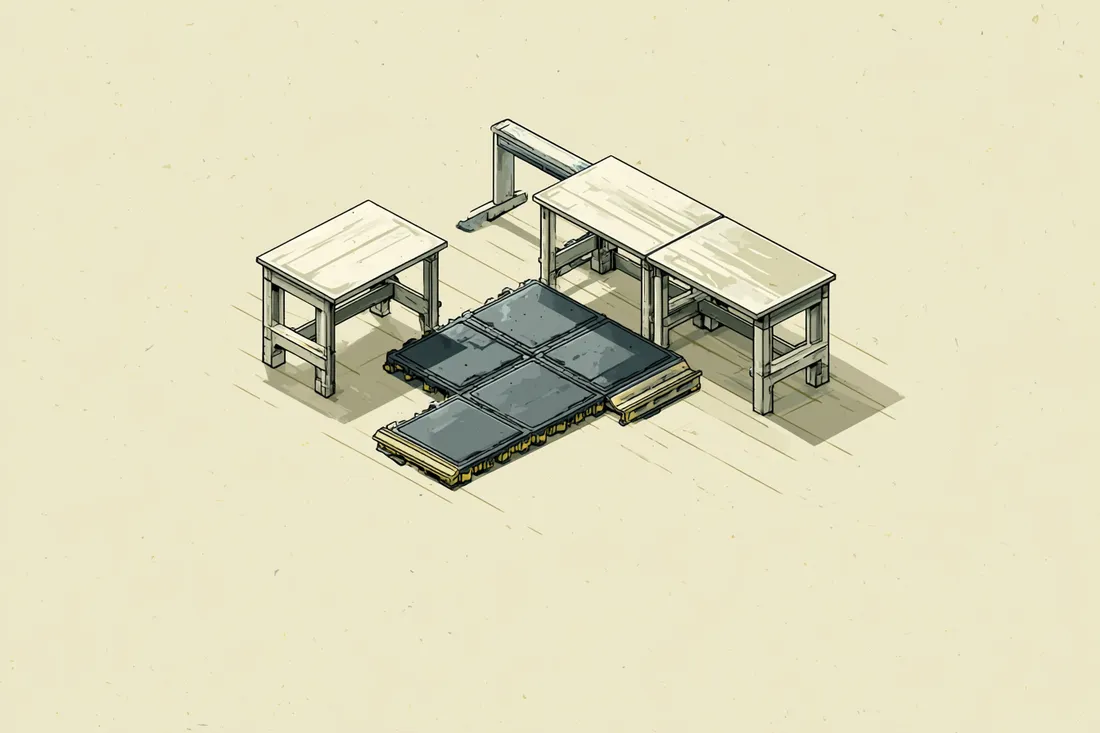
Interlocking tiles are a purchasing model, not just a mat: build coverage to the exact line length, add ramp and corner pieces, swap worn sections individually, and relay the run when a station moves. Best for lines and multi-station floors; a single mat is simpler for one fixed spot. The compound and edge detailing still have to be right.
When modular tiles beat a single mat
Tiles earn their keep when the floor is more than one fixed spot. Because they connect, you can build matting to the exact length of a line, add corner and ramp pieces where carts cross, and cover a run of discrete standing positions station by station. When a tile wears or is damaged, you replace that section instead of the whole run, and when a station moves, the matting relays with it.
That flexibility is the whole point of the format: it turns matting into something you configure and maintain piece by piece, rather than a single fixed object you replace entirely. For discrete-station floors that change with the product, that is a genuine advantage.
When a single mat or runner is simpler
Modular is not automatically better. For one fixed workstation, a singleanti-fatigue mat or a cut-to-length runner is simpler: fewer joins to keep tight and flat, an easier surface to lift and clean, and less to specify and stock. Where the standing zone is continuous rather than a set of separate positions, a runner often beats a grid of tiles.
So the decision is about the floor, not a preference for one format. Discrete, changing stations lean modular; a single spot or a continuous walkway leans toward one mat or runner. See single mat vs interlocking tiles for the head-to-head.
Where interlocking mat tiles are used
Modular tiles suit floors built from repeated standing positions:assembly and production lines, packing and kitting lines, CNC and machining cells, warehouse pick and pack stations, electronics lines, and maintenance areas. Across an industrialfootprint, tiles let one system cover many stations and adapt as the layout changes.
| Need | Why modular helps | What to verify |
|---|---|---|
| Cover a long or multi-station line | Tiles build to the exact run length and add stations as needed | Tile dimensions and a layout plan for your footprint |
| Replace worn or damaged sections | Swap a single tile instead of the whole run | Individual replacement-tile availability and lead time |
| Reconfigure when a station moves | Tiles lift and relay to the new layout | How tiles connect and whether they reuse after a move |
| Keep exposed sides trip-safe | Ramp and corner pieces bevel every edge carts cross | Ramp/corner pieces are stocked for your tile and thickness |
| Match the floor conditions | Tiles come in oil-resistant, ESD and drainage grades | Compound and any oil, ESD or drainage grade you need |
| Ship a large rollout | Tiles palletize and freight more flexibly than long rolls | Weight, freight/LTL and volume pricing for the quantity |
Material and surface still matter
Modular is the format; the compound is a separate decision. Choosenitrile rubber where oil, grease or coolant reaches the floor; an ESD grade for electronics and static-sensitive lines; and a drainage format for wet or chip-heavy zones. The best tiles for a machining cell and for an electronics bench are not the same, even though both interlock.
Firmness matters too. Precise line work needs a stable stance, so favor a firmer surface over a soft one, and confirm the thickness and durometer suit the standing hours and any rolling loads.
Trip safety: joins, ramps and edges
A tile system is only as safe as its edges and joins. Specify ramp and corner pieces on every exposed side so carts, pallet jacks and feet cross the matting safely, keep the joins tight and flat, and replace any tile that lifts or curls. CCOHS is explicit that improperly installed matting is itself a trip hazard, which is why the join and ramp detailing is a real spec point, not an afterthought.
None of this is an OSHA-certified attribute, no mat or tile is "OSHA-approved." It is simply good installation practice that keeps a busy, cart-heavy line safe underfoot.
What to ask a supplier for
A modular system is a purchasing decision as much as a mat, so a good supplier answers all of this at the product level:
- 1Tile dimensions and a layout plan mapping tiles, ramps and corners to your footprint
- 2Ramp and corner pieces for every exposed edge, and how they lock to the tiles
- 3Individual replacement-tile availability and lead time, so you can swap one section
- 4The material or compound, and any oil-resistant, ESD or drainage grade you need
- 5Cleaning and under-tile maintenance, plus weight and freight for a large rollout
Coverage calculator
Estimate your matting coverage
A quick planning estimate of how much matting you need from your own dimensions. It works out area only, no prices, no product claims. Confirm the final sizes, edges and fit with a supplier.
Planning estimate
— sq ft
Enter your stations or run length to see a planning estimate.
Spec paths to consider
Send coverage estimate for a quoteBuild a specification requestPlanning estimate only, confirm with a supplier.
What to confirm before ordering
- Exact standing footprint at each position
- Beveled or ramped edges on exposed sides
- Cart and pallet-jack crossings
- Wet, oil or ESD conditions that change the material
- Replacement sections if you choose modular tiles
- Cleaning access underneath the matting
FAQ
Interlocking tiles: common questions
Straight answers before you specify a modular system.
Are interlocking anti-fatigue tiles better than single mats?
It depends on the floor. Tiles are best for long lines, multiple standing positions and layouts that change, because you cover the exact run, add ramp pieces and replace worn sections individually. A single mat or runner is simpler for one fixed station, with fewer joins to keep flat and clean. Match the format to whether your standing zones are discrete stations or one continuous path.
Can you replace one damaged tile?
That is the main reason to choose modular tiles. When a tile wears, tears or is damaged by oil, you swap that one instead of pulling up the whole run, provided the supplier still stocks matching replacement tiles. Confirm individual tile availability and lead time before you standardize on a system.
Do interlocking mats become trip hazards?
They can if the joins loosen or an exposed edge is left square. Keep joins tight and flat, use ramp and corner pieces on every exposed side so carts and feet cross safely, and replace any tile that lifts or curls. CCOHS notes that poorly installed matting is itself a trip hazard, so the edge and join detailing is not optional on a busy line.
Are modular tiles good for assembly lines?
Yes. Assembly and production lines are a series of standing positions that can move with the product, so modular tiles that build to length, add ramps and swap out individually suit them well. Choose a firmer surface for precise work, a nitrile grade where oil is present, and an ESD grade for electronics. See our assembly line mats page for the full brief.
Get help choosing
Need a modular tile system specified?
Send us the line length or number of stations, the floor conditions, any oil, ESD or wet requirement, and how often the layout changes. We'll return a neutral tile-and-ramp spec you can use with any supplier.
- No obligation
- No paid rankings
- US & Canada