
Welding-Safe Mats
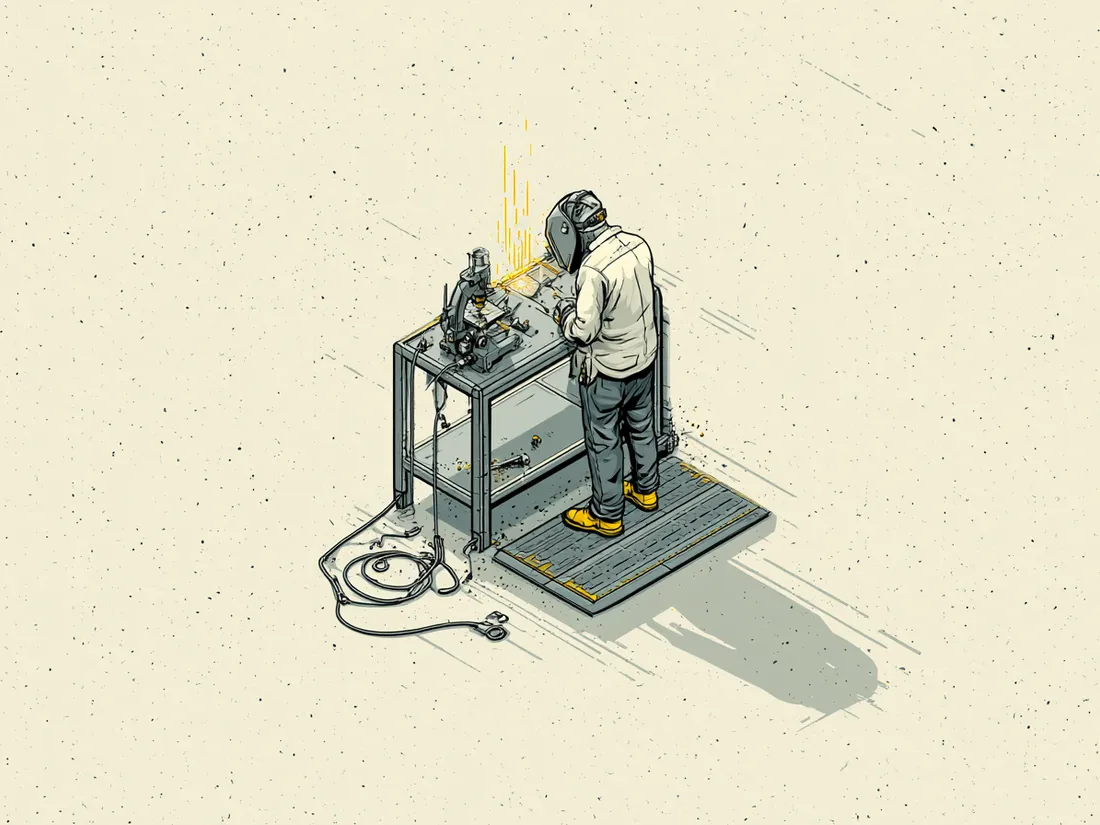
Welding-safe mats are for the fabrication and welding stations where a worker needs anti-fatigue support but the mat itself may face sparks, hot spatter, grinding debris or nearby hot work. The comfort brief is the same as any standing job; the difference is that the surface has to survive what a fabrication floor throws at it.
The critical point up front: an ordinary foam or PVC anti-fatigue mat is not automatically welding-safe. Comfort and spark or heat resistance are separate requirements, so this page covers why welding stations are different and exactly what to verify before you put a mat next to hot work. For the full specification walkthrough, see our guide on anti-fatigue mats for welding and fabrication shops.
In short
Welding-safe mats give anti-fatigue support at fabrication and welding stations where sparks, spatter and grinding debris reach the floor; ordinary foam or PVC mats are not spark-safe, so verify product-specific flame, spark or heat-resistance documentation for your exposure, and keep edges trip-safe and burned sections replaced.
Spark & spatter exposure
Built for stations where hot spatter, sparks and grinding debris reach the floor.
Comfort is not enough
Anti-fatigue cushioning alone does not prove a mat is safe near hot work.
Verify the documentation
Ask for product-specific flame, spark or heat-resistance data for your exposure.
Trip-safe on a busy floor
Beveled edges and tight joins around carts, cables and fabrication traffic.
Why welding stations are different
A welding or fabrication station puts the floor in the line of fire: sparks, hot spatter and grinding debris land where the worker stands, sometimes alongside hot work happening nearby. Add fixed standing for long shifts, heavy boots, and cart and cable traffic across a busy shop floor, and the mat has more to withstand than comfort alone.
A standard foam or PVC anti-fatigue mat is the wrong tool here, sparks and spatter scorch, melt or ignite it. The station still needs anti-fatigue relief, but it has to come from a mat rated for the hot-work exposure, not a general comfort mat pressed into service.
Comfort and spark/heat resistance are separate specs
This is the heart of the page. Anti-fatigue cushioning tells you how a mat feels underfoot; it says nothing about how the material behaves when a spark lands on it. The two are independent properties, and a mat can be excellent at one and unsuitable at the other.
So treat "welding-safe" as its own spec to verify, never an assumption. We do not publish flame or heat ratings for mats, because those depend entirely on the specific product and your exposure. Ask the manufacturer for the product-specific spark, flame or heat-resistance documentation and confirm it matches the hot work at your station.
Where welding-safe mats fit
Map matting to the stations where hot work happens or lands, and match each to its exposure. A fit-up table with no live arc is a different case from a welding bench under constant spatter.
| Zone | Exposure | What to consider |
|---|---|---|
| Welding bench | Direct sparks and hot spatter | Verified spark/heat-resistant grade, firm support |
| Fabrication cell | Intermittent hot work and debris | Welding-safe grade sized to the standing zone |
| Grinding / deburring | Hot metal debris and sparks | Spark-resistant surface, cleanable of grit |
| Maintenance welding area | Occasional hot work | Rated mat kept for the hot-work spot |
| Inspection / fit-up table | Little or no live arc | Durable anti-fatigue mat; confirm any spark exposure |
| Nearby dry workstation | No hot work | Standard industrial anti-fatigue mat is fine |
Material and documentation
Because "welding-safe" is a verified property rather than a material family, the datasheet matters more than the compound name. Ask the supplier for the product-specific flame, spark or heat-resistance documentation, the compound and thickness, edge and ramp details, and cleaning guidance for grit and spatter.
Note that oil resistance and spark resistance are different things: nitrile rubber is the go-to for oil and grease, but oil resistance does not make a mat welding-safe. For the broader material picture see the mat materials hub, and for the wider shop-floor brief see industrial ergonomic mats.
Edges, debris and replacement
On a fabrication floor the mat needs the same trip-safe detailing as any industrial mat, beveled or ramped edges, tight joins and no curling corners, plus a maintenance habit specific to hot work. Inspect mats for burns, cuts and hardened spatter, replace damaged sections rather than working on a compromised surface, and keep grinding grit and debris from building up under the mat.
CCOHS notes that improperly installed matting is itself a trip hazard, and a burned or curling mat at a welding station is both a trip and a housekeeping problem. Build inspection and replacement into the plan from the start.
Procurement checklist
- Count the stations with genuine hot-work exposure versus dry stations that need only a standard mat.
- Document the exposure at each: direct spatter, intermittent sparks, grinding debris or none.
- Confirm cart and cable traffic so edges and joins are detailed for it.
- Decide whether modular sections help, so a burned tile is replaced individually.
- Set a cleaning and inspection/replacement plan for burns, grit and spatter.
Ask a supplier for
Whichever brand you shortlist, request this data before you commit, a good supplier answers all of it quickly:
- 1Product-specific flame, spark or heat-resistance documentation for your actual hot-work exposure
- 2Confirmation that anti-fatigue comfort and spark/heat resistance are both covered, they are separate specs
- 3The compound, thickness and durometer for full-shift standing at a fabrication station
- 4Edge and ramp detailing for cart and cable crossings, and the anti-curl warranty position
- 5Cleaning guidance for grit and spatter, and whether modular sections ease replacement of burned areas
Comparing suppliers? See how to compare anti-fatigue mat suppliers or browse our fair brand comparisons.
FAQ
Welding-Safe Mats: questions
Honest answers specific to this type of matting.
Can regular anti-fatigue mats be used for welding?
No, not as a rule. Standard foam or PVC anti-fatigue mats can scorch, melt or ignite when sparks and hot spatter land on them, so they are not automatically welding-safe. A welding station needs a mat with verified spark, flame or heat-resistance documentation for its exposure, in addition to anti-fatigue comfort.
What makes a mat welding-safe?
A mat is welding-safe only if the specific product is documented as spark, flame or heat resistant for the exposure at your station. It is a verified property of that product, not a material family or a comfort rating. Ask the manufacturer for the product-specific documentation, and never treat a mat as "OSHA-approved", no such certification exists.
Are nitrile mats welding-safe?
Not by default. Nitrile (NBR) rubber is the go-to for oil, grease and coolant resistance, but oil resistance is a different property from spark or heat resistance. A nitrile mat may or may not be suitable near hot work, so confirm the product-specific welding or fire-resistance documentation rather than assuming the compound makes it safe.
Should welding mats be modular or single-piece?
Either can work; the deciding factor is replacement. Modular tiles let you swap a single burned or damaged section instead of the whole mat, which suits a station that takes regular spatter. A single mat is simpler for one fixed bench. Whichever you choose, the spark or heat documentation and trip-safe edges matter most.
Related guides
Go deeper before you specify
How to Choose Ergonomic Matting: A Buyer's Checklist
A buyer's checklist for choosing ergonomic matting: environment, standing time, thickness, durometer, edges, material and procurement.
Read guideNitrile vs PVC Anti-Fatigue Mats: Which Should You Specify?
Nitrile rubber vs PVC foam anti-fatigue mats on oil resistance, cell structure, durability and cost, so you can spec the right one by environment.
Read guideSingle Mat vs Interlocking Tiles: Which Anti-Fatigue Format Fits Your Floor?
Single anti-fatigue mats and runners vs interlocking tiles on layout, replacement, trip edges, cleaning and freight. Which format fits your floor.
Read guideDoes OSHA Require Anti-Fatigue Mats?
No — and no mat is 'OSHA-certified'. What the General Duty Clause actually implies, the evidence to document, and how CCOHS frames it in Canada.
Read guideRelated matting
Compare nearby options

Industrial Ergonomic Mats
Heavy-duty anti-fatigue matting for warehouse, manufacturing and shop-floor workstations, built for durability, oil resistance and modular coverage.
Explore matting
Assembly Line Anti-Fatigue Mats
Modular anti-fatigue matting for production and assembly lines, configured station by station, with ESD and trip-safe options for full-shift standing.
Explore matting
Warehouse Anti-Fatigue Mats
Anti-fatigue matting for fixed standing zones in a warehouse, pick and pack benches, inspection, labeling and shipping desks, matched to concrete floors and cart traffic.
Explore matting
Anti-Fatigue Mats
The hub for anti-fatigue matting, cushioned floor mats that reduce the fatigue of standing on hard surfaces, chosen by workplace, standing time and environment.
Explore mattingGet help choosing
Find the right mat for your standing zone
Tell us the environment, standing hours, floor type, any wet, oil, grease or ESD condition, the approximate size or number of stations, and any sustainability requirements. We’ll return a neutral mat specification you can use with any supplier.
- No obligation
- No paid rankings
- US & Canada