
Warehouse Anti-Fatigue Mats
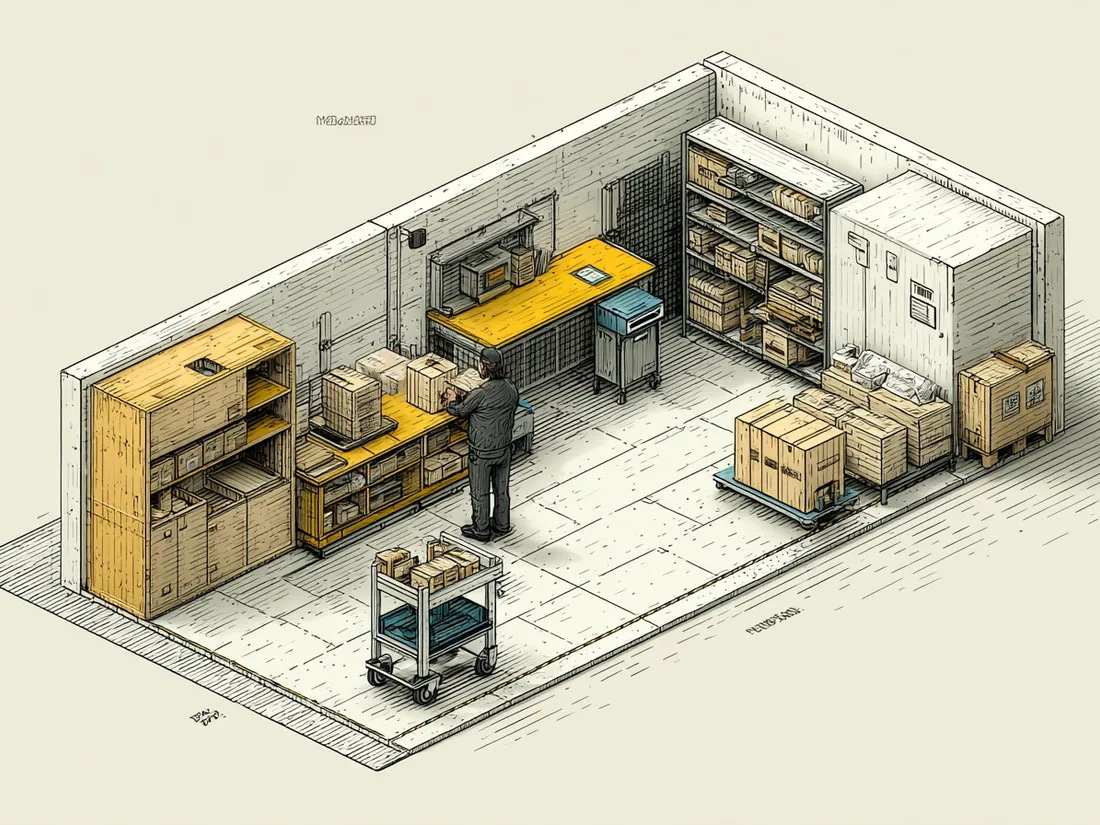
Warehouse anti-fatigue mats belong at the fixed positions where people stand for a whole shift on hard concrete: pack benches, pick and put walls, inspection and returns, labeling and shipping desks, and maintenance benches. On those spots a resilient mat relieves the fatigue of standing on unforgiving concrete.
What they are not for is forklift travel lanes or open walkways. This page covers what makes a warehouse floor different, where matting actually helps, the material and format choices that suit heavy-duty use, and how to keep mats trip-safe around carts and pallet traffic.
In short
Warehouse anti-fatigue mats belong at fixed standing zones on concrete, pack and pick benches, inspection, shipping and maintenance stations, not in forklift lanes; choose durable nitrile, drainage or modular-tile formats sized to each station, with beveled edges kept trip-safe around carts.
Fixed standing zones
Matting at pack, pick, inspection and shipping stations, not in travel lanes.
Built for concrete
Supportive cushioning tuned for long shifts on hard, cold concrete floors.
Durable materials & tiles
Nitrile, solid rubber and modular tiles that take heavy standing and rolling loads.
Trip-safe around carts
Beveled, ramped edges and tight joins where carts and pallet jacks pass.
What makes warehouse floors different
A warehouse floor is hard, cold concrete, often worked across long shifts, with carts and pallet jacks moving close to where people stand. Add dust and debris, seasonal temperature swings in unconditioned space, and standing positions fixed at benches and stations, and the brief is different from an office or a kitchen.
That combination points to durable, supportive matting placed only where people actually stand still, with edges detailed for the cart traffic that passes alongside. Comfort matters, but so do durability, cleanability and staying flat and trip-safe on a busy floor.
Where mats actually belong in a warehouse
Matting earns its place at fixed standing zones, not along routes people walk or vehicles drive. Map it station by station and keep it out of forklift and pallet-jack lanes entirely.
| Zone | Why a mat helps | What to consider |
|---|---|---|
| Pack bench | Full-shift standing at a fixed station | Firm support, beveled edges, sized to the bench |
| Pick / put wall | Repetitive standing and reaching in one spot | Anti-fatigue mat or tiles; keep clear of aisles |
| Inspection / QC | Precise work standing still | Firmer surface for a stable stance |
| Shipping / receiving desk | Standing at a counter or terminal | Low-profile mat, non-slip backing |
| Maintenance bench | Standing with tools, oil possible | Oil-resistant nitrile where grease is present |
| Wet / dirty utility zone | Standing where water or debris collects | Drainage format, cleanable, lift-out |
Material and format choices
The floor conditions set the material. Where oil or grease reaches the floor at a maintenance or equipment bench, choose nitrile rubber; where water or debris collects, a drainage format lets liquids fall below the surface. For a run of pick or pack stations, interlocking tiles cover the line and let you replace worn sections individually.
For the heavy-duty material and durometer detail, the industrial ergonomic mats guidance applies directly, warehouse matting is industrial matting placed at standing stations. Aim for supportive firmness rather than a soft sink, and size each mat to the full standing zone.
Edges, carts and trip control
On a floor full of carts and pallet jacks, the edge is the safety feature. Specify beveled or ramped edges on every exposed side so wheels roll on and off without catching, keep joins tight and flat, and replace any mat with a curling corner. CCOHS notes that improperly installed matting is itself a trip hazard, which matters most where traffic passes close to standing staff.
Keep matting out of forklift and pallet-jack travel lanes unless the product and your own risk assessment explicitly support that use, a mat is for a fixed standing zone, not a vehicle route. No mat resolves forklift or pallet-jack hazards; those are controlled by traffic management, not matting.
Procurement and rollout
- Count the fixed standing stations and size a mat to each, rather than covering whole aisles.
- Consider modular tiles where stations sit in a line or the layout changes.
- Plan freight and weight for bulk mat or tile orders across a large floor.
- Confirm how mats lift out for cleaning underneath, especially in dusty or wet zones.
- Match compound and thickness to oil, wet and load conditions before you commit.
Ask a supplier for
Whichever brand you shortlist, request this data before you commit, a good supplier answers all of it quickly:
- 1A mat sized to each fixed standing station, not coverage of whole aisles or lanes
- 2The compound matched to your floor: nitrile for oil, drainage for wet or debris, solid rubber or tiles for general duty
- 3Durometer or compression figures for full-shift standing and any rolling loads
- 4Edge and ramp detailing for cart and pallet-jack crossings, and the anti-curl warranty position
- 5Weight, freight and how mats lift out for cleaning underneath across a large rollout
Comparing suppliers? See how to compare anti-fatigue mat suppliers or browse our fair brand comparisons.
FAQ
Warehouse Anti-Fatigue Mats: questions
Honest answers specific to this type of matting.
Where should anti-fatigue mats go in a warehouse?
At the fixed positions where people stand for long periods: pack benches, pick and put walls, inspection and QC, shipping and receiving desks, returns, labeling and maintenance benches. Size a mat to each standing zone and keep matting out of walkways and vehicle lanes.
Can warehouse mats be used in forklift lanes?
No, as a rule. Anti-fatigue mats are for fixed standing zones, not forklift or pallet-jack travel lanes, where a mat can become a trip or handling hazard. Only place matting in a traffic lane if the specific product and your own risk assessment explicitly support it. No mat resolves forklift hazards; those are managed through traffic control.
Are interlocking tiles better for warehouses?
For a run of pick or pack stations, or a layout that changes, modular interlocking tiles are practical because you cover the line and replace worn sections individually. For a single fixed bench, one mat or runner is simpler. Match the format to whether your standing zones are discrete stations or one continuous run.
What material is best for concrete warehouse floors?
A supportive, durable anti-fatigue surface sized to each standing station. Use nitrile rubber where oil or grease is present, a drainage format where water or debris collects, and firm solid rubber or modular tiles for general heavy-duty standing. Aim for supportive firmness, not the softest option, and confirm thickness and durometer for your loads.
Related guides
Go deeper before you specify
How to Choose Ergonomic Matting: A Buyer's Checklist
A buyer's checklist for choosing ergonomic matting: environment, standing time, thickness, durometer, edges, material and procurement.
Read guideNitrile vs PVC Anti-Fatigue Mats: Which Should You Specify?
Nitrile rubber vs PVC foam anti-fatigue mats on oil resistance, cell structure, durability and cost, so you can spec the right one by environment.
Read guideSingle Mat vs Interlocking Tiles: Which Anti-Fatigue Format Fits Your Floor?
Single anti-fatigue mats and runners vs interlocking tiles on layout, replacement, trip edges, cleaning and freight. Which format fits your floor.
Read guideDoes OSHA Require Anti-Fatigue Mats?
No — and no mat is 'OSHA-certified'. What the General Duty Clause actually implies, the evidence to document, and how CCOHS frames it in Canada.
Read guideRelated matting
Compare nearby options

Industrial Ergonomic Mats
Heavy-duty anti-fatigue matting for warehouse, manufacturing and shop-floor workstations, built for durability, oil resistance and modular coverage.
Explore matting
Assembly Line Anti-Fatigue Mats
Modular anti-fatigue matting for production and assembly lines, configured station by station, with ESD and trip-safe options for full-shift standing.
Explore matting
Anti-Fatigue Mats
The hub for anti-fatigue matting, cushioned floor mats that reduce the fatigue of standing on hard surfaces, chosen by workplace, standing time and environment.
Explore mattingGet help choosing
Find the right mat for your standing zone
Tell us the environment, standing hours, floor type, any wet, oil, grease or ESD condition, the approximate size or number of stations, and any sustainability requirements. We’ll return a neutral mat specification you can use with any supplier.
- No obligation
- No paid rankings
- US & Canada